The Fuel Crisis Is Over —Your Marina Fuel Pump Didn't Get the Memo.
Crude oil crashed back to pre-war prices by July 2026. Marina fuel docks didn't follow. Here's what the gap means for recreational boating's future.
By Bruno Hoffman, Founder & Chief Evangelist, Marine EV Consortium · August 2026
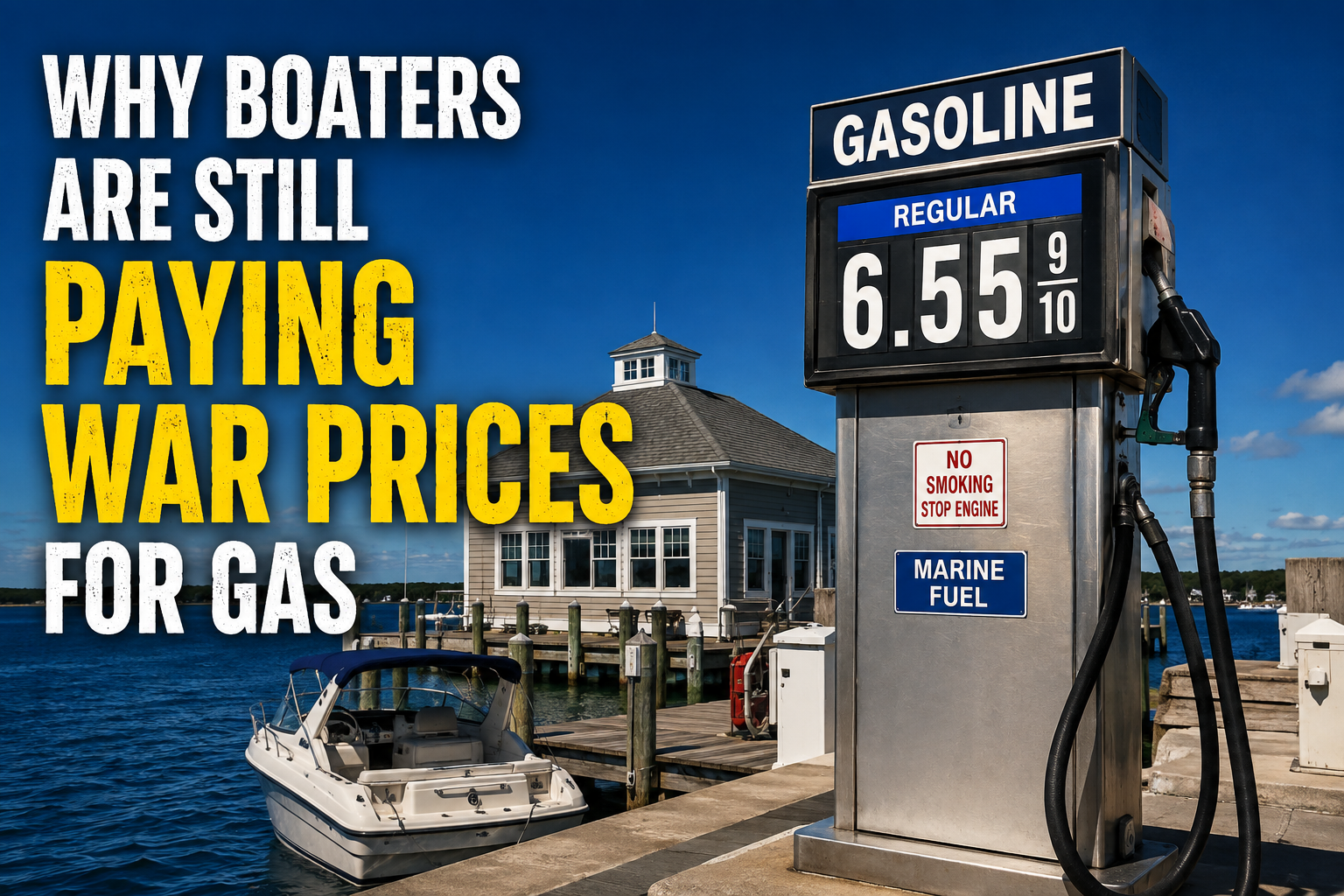
Crude Crashed. The Marina Fuel Dock Didn't Notice.
In June, the United States and Iran signed a deal to reopen the Strait of Hormuz. Crude oil fell back to where it was before the war started. Nobody told the marina fuel dock.
$425 Average fishing-boat fill-up at 2026's spring peak, up from $300 in January
$6.55 Highest per-gallon marina gas price logged in the last two weeks of July
5–7 yrs Typical payback window on electric propulsion's higher upfront cost, from fuel and maintenance savings alone
Short answer, for anyone in a hurry: on pure operating cost — fuel plus maintenance — electric propulsion is now cheaper than gas or diesel for the vast majority of recreational boating use cases, and the gap widened in 2026 for reasons that have nothing to do with battery technology and everything to do with where oil comes from.
What actually happened this year
On February 28, the Strait of Hormuz effectively closed after Israeli and U.S. strikes on Iran escalated into a wider conflict. The strait is a 33-kilometer chokepoint that roughly a fifth of the world's oil supply — about 13 million barrels a day — normally passes through. The International Energy Agency called the resulting disruption the largest in the history of the global oil market. Brent crude, which had been trading in the low $70s, spiked toward $118–120 a barrel in March.
For boaters, that meant marine gas pushing past $5 a gallon and diesel above $5.60 in many regions by April — the difference between a $300 weekend fill-up and a $425 one. Brunswick's own Q1 2026 filing pointed to it directly: U.S. boat retail unit sales fell roughly 9% in 2025, and the company's 2026 guidance assumed only a flat-to-slightly-higher market.
The war ended, on paper, in June. The U.S. and Iran signed a memorandum of understanding on June 18 to reopen the strait. Brent crude averaged $85 a barrel in June and had dropped below $70 by the start of July — essentially back to where it started before the conflict began. If you only followed the oil futures market, you'd assume the crisis was over.
The bill that didn't come down
It isn't. Marina fuel-price data logged in the final two weeks of July — well after crude had normalized — still shows gas docks charging anywhere from $4.95 to $6.55 a gallon at marinas up and down the East Coast. That's not a war premium anymore. That's just what the dock charges now.
This is the part of the fossil fuel argument that rarely gets said out loud: marina fuel pricing doesn't track the wholesale market the way a roadside gas station does. Most fuel docks have one supplier, captive seasonal demand, and no competitor two minutes down the road. When crude spikes, marina prices spike with it. When crude falls, there's much less pressure pushing the price back down. Boaters absorb the spike and then quietly keep paying for it.
Electricity doesn't work that way. A residential or marina electricity rate doesn't move because a chokepoint six thousand miles away shut down. It's regulated, it's local, and for a growing number of marinas it's partly self-generated through solar. The volatility that just cost boaters real money this year is structurally a gas-and-diesel problem. It is not a boating problem.
The real math, season by season
Set aside the geopolitics and look at a normal season. Across the industry cost studies published over the past year, the pattern is consistent even as the exact figures vary by boat size and usage: seasonal energy costs for electric propulsion generally land somewhere between $150 and $1,200, while a comparable gas or diesel boat runs $1,500 to $6,000 or more in fuel alone — before this year's price spike is even factored in.
Maintenance tells the same story. No oil changes, no fuel filters, no winterization, no spark plugs, and far fewer moving parts to fail. Electric propulsion typically runs a few hundred dollars a year in upkeep against $1,500 to $5,000 for a combustion engine over the same season.
Put fuel and maintenance together and most cost analyses land in the same place: the higher upfront price of electric propulsion pays for itself in roughly five to seven years of typical recreational use — and every fuel spike like this spring's pulls that timeline shorter, not longer.
The honest caveats
None of this is a case for pretending gas propulsion has no place left. It does, and MEVC's job is to tell you the truth, not sell you a story.
Upfront cost for electric propulsion is still higher in most segments than a comparable gas setup.
Offshore, long-range, and remote cruising remains gas-and-diesel territory until battery density and charging infrastructure both mature further.
Charging access outside major boating markets is still inconsistent, and that's a real planning problem for fleets.
Battery replacement is a genuine long-term cost, even if it's a far rarer event than a mid-life engine rebuild.
What none of those caveats touch is day-to-day operating cost. That argument isn't close anymore, and this year made the reason why unusually visible.
Why this gap isn't closing
The Strait of Hormuz will not be the last chokepoint story recreational boating lives through. Oil is a global commodity moving through a small number of narrow, geopolitically exposed corridors, and marina fuel pricing has shown, again, that it absorbs the spikes faster than it gives them back. Electric propulsion doesn't carry that exposure — and marinas adding solar generation or battery buffering are starting to insulate themselves from grid pricing too, not just fuel pricing.
That's not a hypothetical. It's the same logic behind the solar-electric charter boats and bidirectional "floating battery" propulsion already showing up in MEVC's partner network — vessels that don't just avoid the fuel dock, they can put power back into it.
A note for MEVC's B2B partners
If you're a marina operator, fleet manager, or charter operator building a 2027 budget right now, this year's fuel numbers are worth modeling explicitly rather than shrugging off as "the war." The volatility is structural, not seasonal. MEVC's certified partner directory exists to help operators evaluate electric propulsion, charging infrastructure, and solar-assisted options against exactly this kind of cost exposure. Explore the partner network at www.marineevconsortium.com.
Quick answers
Is it cheaper to run an electric boat than a gas boat in 2026?
On operating cost — fuel and maintenance — yes, for the large majority of recreational use cases. The upfront price gap is real but shrinks every time gas prices spike.
Why are marina gas prices still high if oil prices dropped in June?
Marina fuel pricing lags and often ignores wholesale swings, because most docks have a single supplier and a captive seasonal customer base. Retail marina prices logged in late July were still elevated even after crude fell back near pre-war levels.
How long until an electric boat's higher upfront cost pays for itself?
Roughly five to seven years under typical recreational use, based on fuel and maintenance savings alone — and that timeline shortens whenever gas prices rise.